Monday, March 4, 2019

My Dad

Since my dad passed away in January, I have kept retrieving from the back of my mind how he influenced the way I have lived in the past many years. He seldom talked to me anything formal about study, work or life, presumably not to my brother and sister either. In fact, I can't recall a single instance where he sat us down for a heartfelt conversation about any substantial life topics. But as I thought about what he did and made us do, I can almost conclude without a single doubt that I have all along been copying him. I can easily come up with a long list of things I have learned to do from watching him do, like peeling apples, frying eggs with a Chinese wok, stir-frying choy sum with beef, fixing a carton box, writing cheques with Chinese numeric characters, riding a push bike, calligraphy, .... and many useful skills! However, I probably never realized when I was young that he had imperceptibly bequeathed to me and my two siblings the way he treated people and his faith in God.

After he left, I found myself reflecting on the profound wisdom he had imparted to us. First, he was nice to people and his mantra was "When helping others, do not calculate!" I had witnessed how seriously he involved himself in voluntary works in Cheung Chau Life Saving Club, Auxiliary Medical Service, Chung Shak Hei Elderly Home, The Lady of Fatima Church, and Cheung Chau Rural Committee. However, it was during his funeral service that I learned of countless other acts of selflessness he had performed. While I have certainly not achieved the same magnitude of impact as he did, I have always strived to empathize with others and extend a helping hand whenever possible.

My father had an enormous amount of faith in God. I can never forget the way he reacted when I asked whether he was anxious about a pending open-heart surgery back in 1993, hoping to make him feel easier before the operation. I was speechless when I heard him say in less than a blink of an eye, "No! Nothing to be scared of? God is with me! (驚咩?有乜好驚?天主會同我一齊!)" He was actually very calm, quite unconcerned about any possible complication of the operation, and without a tiny bit of fear, and that moment I learnt the importance of having faith, and how faith helped overcome fear! Leave it all to God, and nothing needs to be worried about!

Now he has gone, but certainly not forgotten, especially his double package of life: be nice to people and have faith in God!


March 4, 2019

Saturday, January 12, 2019

「風雨之後,也無風雨」


今日,到灣仔天地圖書參加洪朝豐先生的新書發佈會,聽這位曾患鬱躁症、飽受癌魔折磨的人分享他「風雨之後,也無風雨」的體會。半個小時訴說患病的故事,天不絕人,人間亦有情,令人感動!明白到原來自己有多強並不重要,能“放下“才是最重要!經歷過人生無常,領悟活著最大的“秘密”竟是簡單的“順其自然”!

洪先生,加油!


2019年1月12日

Thursday, January 3, 2019

香港的「私處 Centre」

正所謂「唔怕生壞命,最怕改壞名!」剛落成的香港戲曲中心,英文翻譯為「Xiqu Centre」,外國人毫無頭緒,而大部份香港人不懂普通話拼音,也看得一頭霧水!
如果翻譯英文名稱的目標是為了給外國人(或不懂華文的遊客)知道這座別出心裁的建築物為何物的話,Chinese Opera 理應是最貼切了!但官方卻認為中國戲曲不應該譯作 Chinese Opera,憂慮會誤導公眾,以為中國戲曲乃係承傳自西方歌劇,最終敲定為「Xiqu Centre」。
換過角度看,縱使"opera"作爲中國戲曲的英文翻譯有不足之處,而成立香港戲曲中心的主要目的是為粵劇表演團體提供表演場地,觀眾也大多來自粵語區。那麼,"Hei Kuk Centre"是否更有意義?

若按此等邏輯來做翻譯,恐怕 Hotel 應該改為 kezhan (中國自古已有"客棧"),Breakfast 在餐廳的菜單上應叫 Zaofan (中國人自古都吃"早飯") ,「白粥油炸鬼」肯定要譯作 Baizhouyoujiagui。即是全部不用翻譯,以免令人誤會承自西方!


2019年1月3日

Tuesday, October 30, 2018

「承受清風」— 宗教遇上科學


小弟有幸在演讀劇場「承受清風」中飾演兩個小配角1,在享受演讀的樂趣之餘,也乘機從所飾演的角色中細味人生和反思劇本帶出的意義。「承受清風」的劇情2是建構於上世紀初傳統宗教與科學之間的矛盾,一位教師由於講授達爾文的進化論,間接否定了聖經創世紀對世界和人類起源的描述,遭田納西州州政府起訴,引發一場轟動美國的法律訴訟,全劇的主線透過控辯兩方律師的精彩辯論,道出人雖然擁有與生俱來的思考自由,但往往受制於社會傳統觀念,加上自我規範和約束(例如法例、習俗),無法衝破禁錮思想的樊籠。

其實,宗教與科學並無矛盾之處,問題在於解讀的方式。聖經是二千多年前寫下的,而舊約聖經的文學體裁是寓言體3,並非對事實的陳述,重點是它的信仰和道理。以寓言體寫成的宗教著作當然不能與科學相提並論,而且,舊約聖經是根據當時(二千多年前)的社會環境和民眾的知識水平及接受程度而寫成,絕對不能用現代的科學邏輯來解讀。伊索寓言中的動物真的會說話嗎?創世紀旨於建立「神」作為萬物的主宰的基本信仰,要理解創世紀就不能是純粹從字面去解讀。劇中也多次強調不能用聖經的「每一個字」來與科學對比,字面的「一日」也可以寓意為千萬年!

每個年代都有既定的一套價值觀和道德觀,「承受清風」就正正說明了這一點。在上世紀初,宣揚達爾文的學說乃係離經叛道的行為,劇中的法庭代表了那個年代的道德觀念和法治標準,法官拒絕科學家作供,被告最終也毫無懸念的被判罪名成立。在法律面前,代表當時的既有習俗、觀念和制度的一方是順理成章的獲勝。把「承受清風」投射到今天的香港社會,我們的思想同樣被現行的觀念和政治尺度所箝制,新的觀念或政治主張,縱然在目前被否定,甚至被打壓,但誰能估計,數十年後這些觀念和主張會否變成理所當然,為大部份人所接受?大家可拭目以待!


2018年10月31日


________________________1 演讀劇場「承受清風」2 Inherit the Wind (Play) — Wikipedia3 寓言 — Wikipedia

Tuesday, September 25, 2018

How network science assesses Hong Kong's high speed railway?


On September 23, 2018, Hong Kong celebrated the opening of its high speed railway that has been described by government officials as the most beneficial infrastructure project for Hong Kong.1 The $11 billion dollar project indeed provides an alternative mode of travel to major cities in the Chinese Mainland, and according to the government's prediction is expected to hit a daily passenger volume of 80,000 (which was recently downward adjusted). The question, however, is whether it really justifies the huge construction cost and the subsequent expensive maintenance cost.

Network science, a rapidly growing discipline in physics and mathematics, may shed light on the pros and cons of Hong Kong's high speed railway as a means for connecting with the rest of China. A railway system is a network, which is characterized by a set of so-called nodes connected by links. For a railway network, a station is a node, and its importance may be measured by a few parameters, among which the "degree" of a node is often used to assess its connectivity. In non-technical terms, the "degree" of a station is just the number of other stations it connects immediately with. A high-degree station is what we normally refer to as a hub, like Shinjuku in Tokyo, King's Cross St Pancras in London, or Wuhan in China. Obviously, a hub will always attract a large volume of traffic as it radiates and connects to multiple nodes. In a railway network, the majority of nodes has a degree of two, connecting only two neighboring nodes. A few, however, has a high degree.

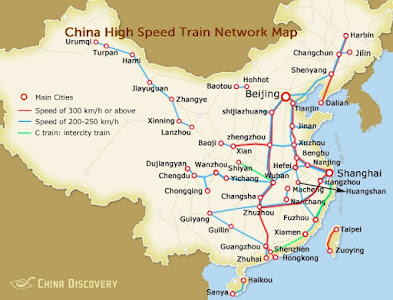
According to the latest railway map2,

  • Degree of Guangzhou = 7 (double links counted as 2)

  • Degree of Shenzhen = 5

  • Degree of Hong Kong = ?


How about Hong Kong? It has the least degree, i.e.,
one, as it is situated at the end of a line. Unless such a node has other fundamental attributes that make it more important than others, it cannot be an important node from the network's point of view. In network science, the so-called weight of a node may make it more important, like the points-of-interest, population size, social activities, financial activities, etc. Hong Kong, being a Special Administrative Region, may have a heavier weight, but the Hong Kong high-speed railway station is topologically a terminal node and can never serve to connect others. This remains a fundamental constraint, unlike Hong Kong's airport which has been developed to be a hub. The key point is that the railway system, restricted by topology, cannot allow any station to develop into a hub if it was not designed for such a function.

Hong Kong is a one-degree node connecting permanently with an intermediate Futian station which then connects to Shenzhen North station, and that's it. Theoretically, the topological efficiency (node's) is also inherently low as it is located on one single route and right at its terminal. Other network attributes will also consistently rate Hong Kong's station as a less important node, e.g., the so-called betweenness centrality that reflects a node's ability of carrying passengers through it from various possible itineraries.

Hong Kong as a terminal station in the high-speed rail system is an inherently unimportant node. The high-speed railway is expected to play a very limited role as a means of transportation. Simply put, it connects only to Shenzhen, through which to other nodes serially (along one-dimensional lines). Under the current topological constraints (i.e., HKSAR being a boundary point, without through traffic), Hong Kong's high-speed rail has no room for further development. A literal dead-end so to speak!

September 26, 2018

Recent Popular Post